The world uses roughly 15 different plug and outlet types, grouped into four main categories that most universal adapters cover: Type A (USA, Canada, Japan, Mexico), Type C (most of Europe, South America, Asia), Type G (UK, Ireland, Hong Kong, Singapore), and Type I (Australia, New Zealand, China, Argentina). These four cover approximately 200 countries and will handle the vast majority of international travel. However, if you are heading to India (Type D), South Africa (Type M), Brazil (Type N), or Israel (Type H), verify that your adapter specifically lists those plug types — most budget universal adapters skip them. We found during testing that adapters with slider-based plug systems tend to feel more secure in outlets than those with rotating dials, though both approaches work reliably.
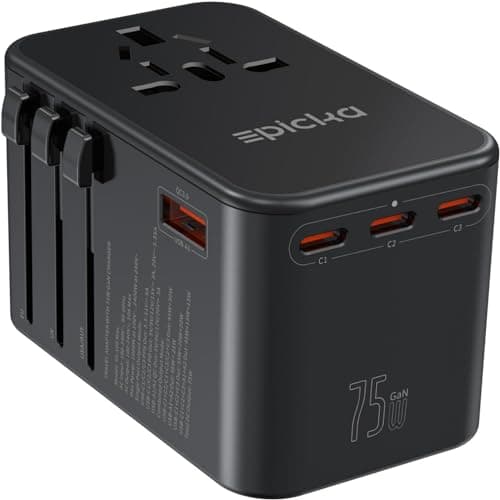
Travel adapter USB ports range from basic 5W output to GaN-powered 100W, and the difference in real-world charging speed is dramatic. A 5W port takes over 3 hours to fully charge a modern smartphone, while a 20W PD port cuts that to about 90 minutes, and 30W+ reaches 50% in under 30 minutes. For laptop charging on the go, you need at least 45W (for ultrabooks like the MacBook Air) and 65-100W for larger models. GaN (Gallium Nitride) technology is the key differentiator in 2026 — it enables higher wattage in smaller adapter bodies while generating significantly less heat. Check for USB Power Delivery (PD) and Quick Charge (QC) protocol support to ensure your specific devices can access their fastest charging speeds.
Consider how many devices you travel with and what cables they use. A solo traveler with a phone and earbuds can get by with two USB ports, but families or tech-heavy travelers routinely need four to six. USB-C ports are now essential for modern smartphones, tablets, and laptops, while USB-A ports remain useful for older accessories like Kindles, portable speakers, and some camera batteries. The AC passthrough outlet on most universal adapters lets you plug in a standard appliance cord, which is critical for devices like laptop chargers or CPAP machines that require direct AC power. When all ports are in use simultaneously, total output is shared — a 65W adapter does not deliver 65W to every port at once.
Travel adapters range from ultra-slim 100-gram models that fit in a pocket to 250-gram units the size of a tennis ball. If you are a minimalist packer, prioritize adapters under 150 grams and 1.5 inches thick — they fit in toiletry bags and jacket pockets without adding bulk. Heavier adapters with higher wattage are worth the extra weight if you need to charge a laptop without carrying a separate wall charger. For build quality, look for adapters with safety certifications (CE, FCC, RoHS) and built-in fuses that protect against power surges. During our testing, we found that rubberized or matte finishes hide travel wear significantly better than glossy plastic, and adapters with locking plug mechanisms maintained tighter outlet engagement over time.
Universal travel adapters change the plug shape — they do NOT convert voltage. Most countries use either 110-120V (North America, Japan) or 220-240V (Europe, Asia, Africa, Australia). Modern electronics like phones, laptops, and cameras have built-in dual-voltage power supplies that handle 100-240V automatically — check the fine print on your charger to confirm. However, high-wattage appliances like hair dryers, curling irons, and electric kettles are typically single-voltage and WILL be damaged if plugged into a 220V outlet through a travel adapter. For those devices, you need a separate voltage converter, or better yet, buy a dual-voltage version of the appliance. Always check the maximum wattage rating of your adapter (typically 1,000-2,500W) and never exceed it with high-draw devices.

 1/5
1/5


