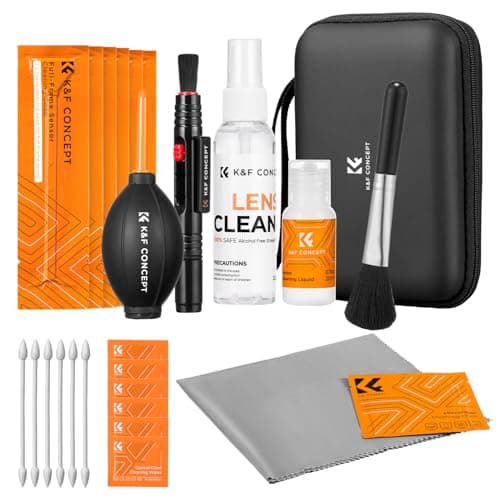
Camera cleaning kits split into two broad categories: those designed for external lens and body cleaning, and those that include sensor swabs for internal sensor cleaning. Lens and body kits contain air blowers, cleaning pens, microfiber cloths, and fluid, and are safe for daily use by any photographer. Sensor cleaning kits add specialized swabs matched to your sensor size (16mm for APS-C, 24mm for full-frame) and require a steadier hand and more careful technique. If your images show recurring dust spots that blur correction in Lightroom cannot remove, a sensor kit is what you need. If spots only appear on lens surfaces, a standard lens kit will do the job.
The most important specification when buying a sensor cleaning kit is whether the swabs match your sensor format. APS-C sensors (found in cameras like the Canon Rebel series, Nikon D3500, and Sony a6000 series) use 16mm swabs, while full-frame sensors (Sony a7 series, Canon R5/R6, Nikon Z6/Z7) require 24mm swabs. Using the wrong size will either leave uncleaned strips on the sensor or require more passes than necessary. Micro Four Thirds cameras use an even smaller 14mm swab. Always confirm your sensor format before purchasing, and never use a full-frame swab on a smaller sensor, as excess material can fold and cause smearing.
Optical cleaning solutions must be alcohol-free or formulated specifically for coated glass to avoid stripping the anti-reflective, hydrophobic, and fluorine coatings on modern lenses and sensors. Household glass cleaners, isopropyl alcohol above 70 percent concentration, and ammonia-based products can permanently damage lens coatings in a single application. Look for solutions labeled as optical-grade, ammonia-free, and alcohol-free or isopropyl-based at low concentration. The best kits from K&F Concept, VSGO, and Altura Photo all include solutions formulated to these standards. When in doubt, distilled water applied via a dedicated swab is safer than an unknown commercial product.
More components in a kit does not always mean better cleaning results. Kits with 15, 18, or 21 pieces often include inexpensive filler items like generic lens wipes or low-quality brushes that can scratch surfaces if used carelessly. Experienced photographers often prefer to build a custom kit with fewer, higher-quality pieces such as the Giottos Rocket Blaster for airflow, VSGO lens pen for glass surfaces, and dedicated VSGO or K&F sensor swabs, rather than relying entirely on a bundled kit. Beginners typically benefit from a complete kit that removes buying decisions, while experienced photographers are better served evaluating each component category individually.
Most sensor cleaning kits include between six and twelve swabs, which sounds like a lot until you realize that single-use swabs should never be reused, and a particularly dusty shooting environment might require cleaning after every outdoor session. Consider how often you shoot in dusty, sandy, or humid conditions when choosing a kit, and factor in the cost and availability of swab refills for your chosen brand. VSGO, K&F Concept, UES, and Altura Photo all sell their swabs as standalone refill packs on Amazon, making it easy to restock without repurchasing the full kit. The cleaning fluid also runs out independently of swabs, so check that refill fluid is readily available.

 1/5
1/5


