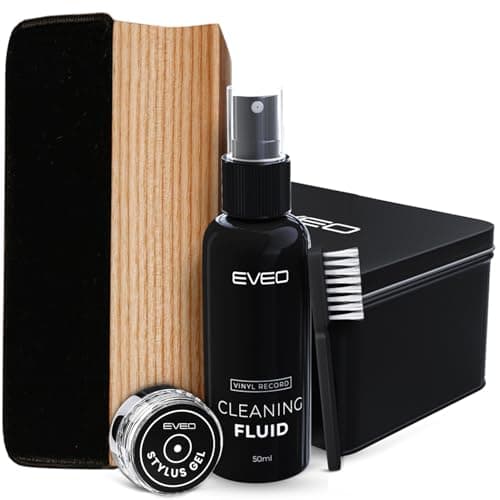
Keeping your records clean is the single most important thing you can do to preserve sound quality and extend the life of both your vinyl and your stylus. At minimum, every listener should own a carbon fiber anti-static brush for quick dry cleaning before each play, and a velvet brush with cleaning solution for periodic deeper cleaning. For serious collectors, a dedicated record cleaning machine is a worthwhile investment, but a good manual cleaning kit handles 90% of maintenance needs. Anti-static inner sleeves are equally critical — replacing the flimsy paper sleeves that ship with most records dramatically reduces the dust and static that cause surface noise over time.
Every turntable needs a phono preamp to boost and equalize the tiny signal from the cartridge to a level your amplifier or powered speakers can use. Many budget and mid-range turntables include a built-in preamp, but these are almost always mediocre — upgrading to even a modest external phono preamp like the Fosi Audio Box X2 produces an immediately audible improvement in clarity, dynamics, and bass control. When shopping for a preamp, confirm whether your cartridge is MM (moving magnet) or MC (moving coil), as most affordable preamps only support MM. A dedicated grounding post is essential for eliminating the hum that plagues many setups.
The mat between your platter and your record has a surprising impact on sound quality. Stock felt mats generate static and offer minimal vibration damping, while rubber mats can over-damp the sound and make it feel lifeless. Cork has emerged as the preferred material for most audiophiles because it naturally reduces static, provides effective vibration damping without deadening the sound, and maintains a neutral tonal character. Look for a mat thickness between 2mm and 4mm to maintain proper vertical tracking angle without requiring tonearm height adjustments, and choose a design with a recessed center label area for optimal record contact.
Your turntable is a mechanical device that reads physical grooves with a microscopic diamond tip, which means any external vibration that reaches the platter will be heard as noise in your playback. Common culprits include footsteps on wooden floors, bass energy from nearby speakers, and resonance from the shelf or surface your turntable sits on. Isolation feet made from silicone or rubber absorb these vibrations before they reach your turntable, and the improvement is especially dramatic in apartments, rooms with hardwood floors, or setups where the turntable shares a surface with speakers. A record weight or clamp further couples the record to the platter, reducing airborne vibration pickup.
Proper storage is essential for maintaining your collection's condition and value over decades. Records should always be stored vertically — never stacked flat, which causes warping under weight. Outer sleeves protect album jackets from shelf wear, ring wear, and dust, while quality inner sleeves prevent the micro-scratches that paper sleeves inflict with every insertion and removal. Acid-free, archival-quality materials are worth the modest premium over generic plastic, as cheaper materials can yellow, off-gas, and actually damage your covers over time. A dedicated display stand near your turntable makes the ritual of selecting and showcasing albums part of the listening experience.
Setting correct tracking force is the most important calibration step for any turntable, yet most listeners never verify their factory settings. Too much force accelerates groove and stylus wear, while too little causes the stylus to skip and mistrack, damaging your records in a different way. A digital stylus force gauge that reads to 0.01g resolution costs under $15 and takes minutes to use — it is one of the highest-value purchases in all of audio. Always set tracking force to the middle of your cartridge manufacturer's recommended range as a starting point, then fine-tune by ear if desired. Pair this with regular stylus cleaning using a gel or brush to keep your needle performing at its best.

 1/5
1/5


